QEMU
Category of QEMU:
Tags:
Open SourceDesktop AppAPI
Description:
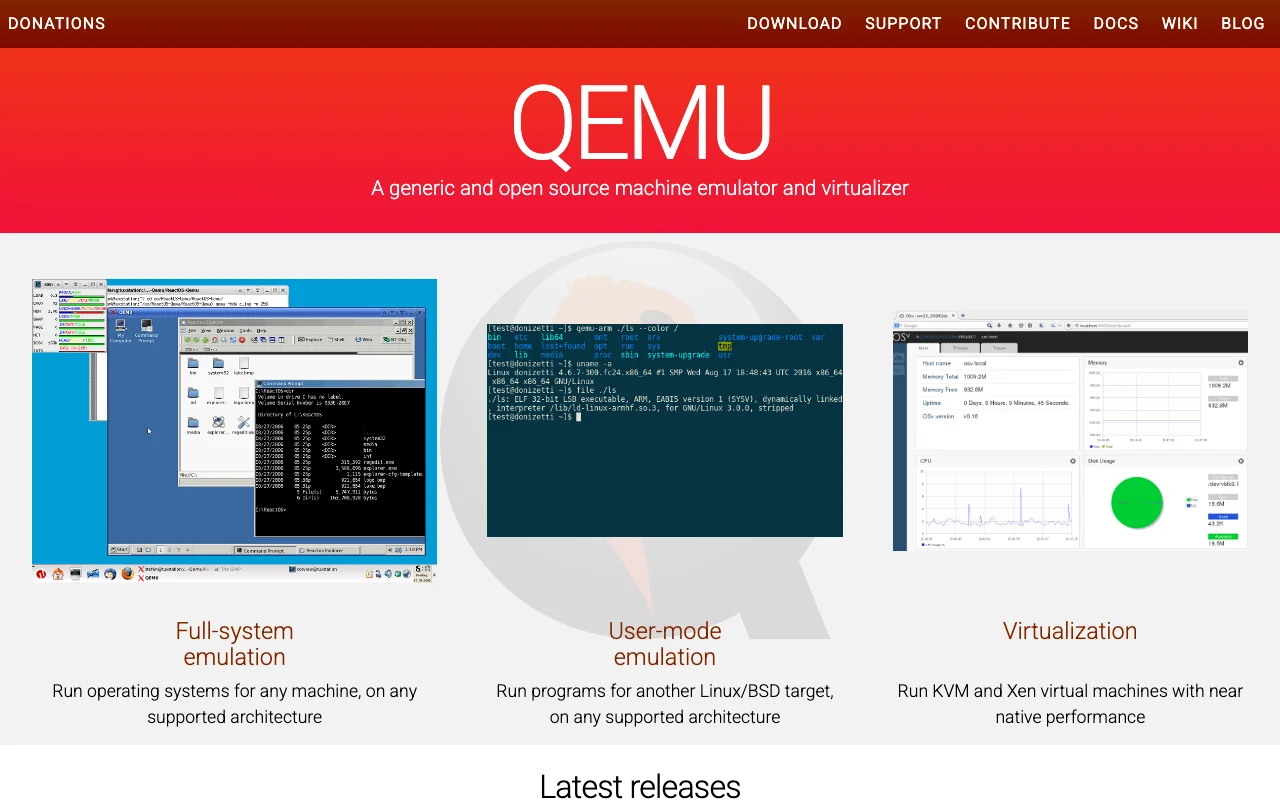
QEMU is a powerful open-source machine emulator and virtualizer that allows users to run operating systems and software designed for one hardware architecture on a completely different one. It excels at CPU emulation and supports a wide array of guest architectures. QEMU can also emulate various hardware devices, making it indispensable for embedded systems development, security research, and test
QEMU: Comprehensive Machine Emulation and Virtualization Overview
QEMU is a powerful open-source machine emulator and virtualizer designed to run operating systems and applications from one machine architecture on another. It offers robust CPU emulation, allowing for cross-architecture execution, and supports a vast range of guest architectures including x86, ARM, MIPS, and PowerPC. QEMU can also emulate a wide variety of hardware devices, such as network interfaces, disk controllers, and USB devices, making it a flexible solution for diverse use cases.
The tool's capabilities are significantly enhanced when used with KVM (Kernel-based Virtual Machine) on Linux, enabling hardware-accelerated virtualization that achieves near-native performance. This synergy makes QEMU a go-to solution for running virtual machines efficiently. Its applications span across testing software on different architectures, developing embedded systems, conducting security research, and building cloud computing infrastructure. The open-source nature of QEMU fosters a strong community, ensuring continuous development and broad support.
Key Features and Capabilities of QEMU
- CPU Emulation: Run software for different processor architectures.
- Hardware Emulation: Simulate various hardware components and devices.
- KVM Virtualization: Achieve high-performance virtualization on Linux.
- Multi-Architecture Support: Emulate a wide range of guest systems.
- Extensive Device Support: Emulate network, disk, and USB devices.
Best Use Cases for QEMU
- Running diverse operating systems on a single host.
- Testing software compatibility across architectures.
- Developing and debugging embedded systems.
- Security analysis and reverse engineering.
- Creating virtualized environments for cloud services.
- Cross-platform software development and testing.
How to Contact QEMU Support
QEMU is an open-source project, and support is primarily community-driven. You can find comprehensive documentation and resources on the official QEMU website. For assistance, consider engaging with the QEMU community forums and mailing lists. Specific support channels are not directly provided by a central entity.
Reviews0
Would you recommend QEMU? Leave a comment
No reviews yet. Be the first to share your experience!
Alternatives
The best modern alternatives to QEMU
DOSBox
5.0
Last update: 23 hours ago
DOSBox is a free and open-source emulator designed to run old DOS games and applications on modern operating systems. It meticulously emulates a full x86 PC environment, complete with sound, graphics, and input/output capabilities. This powerful tool allows users to relive classic gaming experiences and utilize legacy software that would otherwise be incompatible with current hardware and operatin
View DOSBoxTags:Open SourceWindows
View DOSBoxScummVM
5.0
ScummVM allows you to play classic graphical adventure and role-playing games on modern systems by replacing their original executables. It supports over 325 games from studios like LucasArts and Sierra, offering a gateway to retro gaming across Windows, macOS, Linux, iOS, and Android.
Open SourceDesktop AppWindows
View ScummVM
Coreboot
5.0
coreboot is a high-performance Open Source firmware platform that significantly accelerates the boot process for computers and embedded systems. It prioritizes security and user control, allowing for deep customization and auditability of the system's foundational software. Unlike proprietary firmware, coreboot empowers users with transparency and flexibility, making it a preferred choice for thos
Open SourceSecurityDev Tools
View Coreboot
Lakka
5.0
Lakka is a free and open-source operating system designed to transform your Raspberry Pi into a dedicated retro gaming console. Built upon the powerful RetroArch emulator, Lakka offers a lightweight and user-friendly experience for enthusiasts looking to relive classic gaming moments.
Open SourceFreeLinux
View Lakka
Xpadder
5.0
Xpadder is a popular software tool that allows users to map their game controllers, joysticks, and other input devices to keyboard and mouse functions. This enables gamers to use their preferred controllers with games that do not natively support them, or to customize existing controller layouts for enhanced gameplay. Xpadder provides a flexible and user-friendly interface for creating and managin
Desktop AppWindows
View Xpadder
New Tools Releases
Recently added tools
Apache Subversion
5.0
Apache Subversion (SVN) is a robust, open-source, centralized version control system designed for managing code and project data. It offers reliability, simplicity, and scalability, making it suitable for individual developers and large enterprise operations. Subversion excels at tracking changes, facilitating collaboration, and ensuring data integrity. Its widespread adoption in both open-source
Open SourceGPLFor Developers
View Apache Subversion
Spamgourmet
5.0
Spamgourmet provides free, auto-creating email addresses that forward messages to your primary inbox and then expire, acting as a powerful spam blocker. It's ideal for anyone who wants to protect their main email from spam when signing up for new services or giving out contact information. The tool requires no installation and is designed for minimal user intervention after initial setup, making i
FreeWeb AppPrivacy-Focused
View Spamgourmet
Crew
5.0
Crew is a high-yield checking account that actively manages your finances through automated 'pockets,' paycheck splitting, and bill management. It offers a subscription-free approach to personal finance, empowering users with control and clarity over their money, alongside features like parental controls and competitive APY on deposits. Banking services are provided by Bangor Savings Bank, Member
Trial AvailableSubscription-BasedMobile App
View Crew
Ludwig
5.0
Ludwig is an open-source declarative deep learning framework that simplifies building, fine-tuning, and deploying ML models using a YAML file. It supports various data modalities and scales seamlessly from a laptop to distributed clusters, offering the flexibility of PyTorch with the ease of AutoML.
Open SourceFor DevelopersAutomation
View Ludwig
Reeder
5.0
Reeder is a modern news reader that unifies RSS feeds, videos, podcasts, and social media into a single timeline. It features seamless cross-device syncing via iCloud, powerful custom filters, and a simple way to save links. Reeder prioritizes a clean interface and user privacy, making it an efficient tool for content consumption.
Desktop AppMobile AppmacOS
View Reeder
SurveyJS
5.0
SurveyJS is a powerful JavaScript library that enables developers to build custom survey and form management systems directly within their applications. It offers unparalleled flexibility through JSON-based configuration, ensuring users retain full ownership of their data and can handle an unlimited number of responses. The latest version, v3.0, introduces significant enhancements like a shared st
Open SourceFor Developers
View SurveyJS
Small Basic
5.0
Small Basic is a free, beginner-friendly programming language developed by Microsoft, designed to make coding accessible and fun for learners of all ages. It simplifies complex programming concepts with an easy-to-understand syntax and a built-in Integrated Development Environment (IDE) that includes helpful features like syntax highlighting and debugging tools. This educational tool empowers user
Open SourceFor StudentsFor Teachers
View Small Basic
Scenari Dokiel
5.0
Scenari Dokiel is a high-performance distributed ledger technology utilizing a hybrid consensus mechanism for rapid transactions. Ideal for DeFi, supply chain management, and gaming, its scalable and secure architecture empowers developers to build next-generation decentralized applications with confidence and efficiency.
AutomationWeb3Open Source
View Scenari Dokiel