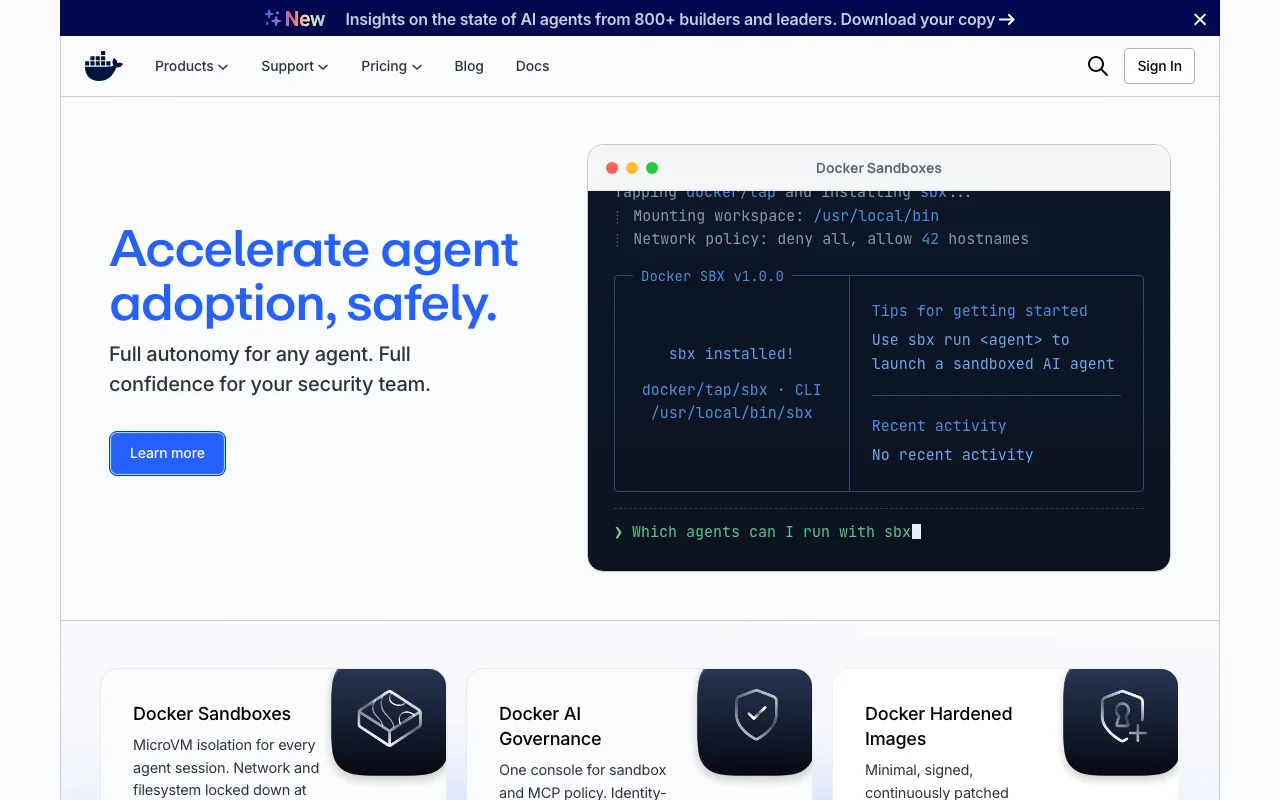
Docker
Category of Docker:
Tags:
CLI ToolFor DevelopersOpen Source
Description:
Docker is a leading platform that empowers developers to build, ship, and run applications efficiently. By packaging applications with their dependencies into standardized, lightweight containers, Docker ensures consistency across diverse environments. This simplifies complex workflows, accelerates development cycles, and enhances application isolation and security. Ideal for individual developers
Introduction to Docker and Its Benefits
Docker is a revolutionary platform designed to streamline the development, shipping, and deployment of applications. It achieves this by enabling developers to package an application along with all its dependencies-such as libraries, system tools, code, and runtime-into a single, executable unit known as a container image. This containerization ensures that applications run consistently and reliably across different computing environments, from a developer's laptop to a testing server and finally to production.
The primary benefit of Docker lies in its ability to eliminate the 'it works on my machine' problem. By isolating applications and their dependencies, Docker guarantees that the software will behave the same way regardless of the underlying infrastructure. This leads to faster development cycles, easier collaboration among teams, and more robust and secure deployments. Docker's ecosystem, including Docker Hub for image sharing and Docker Desktop for simplified local development, further enhances its appeal to developers and organizations seeking efficiency and scalability.
Getting Started with Docker: Quick Setup Guide
To begin using Docker, the first step is to download and install Docker Desktop, which is available for Windows and macOS. Once installed, you can start by pulling an existing Docker image from Docker Hub or by creating your own using a Dockerfile. Running a container is as simple as executing a single command, allowing you to quickly test applications or services in an isolated environment. Familiarizing yourself with basic Docker commands like docker run, docker ps, and docker build will accelerate your journey into containerization.
Top Features and Highlights of Docker
- Containerization: Package applications and dependencies into portable containers.
- Image Registry: Store and share container images with Docker Hub.
- Orchestration Tools: Manage and scale containerized applications effectively.
- Developer Workflow: Streamline development with Docker Desktop and CLI.
- Environment Consistency: Ensure applications run the same everywhere.
Who Benefits Most from Docker
- Developers seeking to ensure code consistency across environments.
- Teams collaborating on complex software projects.
- Organizations adopting microservices architectures.
- DevOps engineers automating deployment pipelines.
- Anyone looking to simplify application testing and management.
- Businesses aiming for faster release cycles and scalability.
Docker Help and Support Resources
Docker offers extensive documentation and community support through its official website. For specific issues or inquiries, you can explore the Docker Hub community forums or consult the official Docker documentation for detailed guides and troubleshooting tips. For enterprise-level support, commercial offerings are available.
Reviews0
Would you recommend Docker? Leave a comment
No reviews yet. Be the first to share your experience!
Alternatives
The best modern alternatives to Docker
Coder
5.0
Last update: 1 days ago
Coder is an open-source, self-hosted remote development environment designed to accelerate software delivery. It provides developers with secure, consistent development workspaces, whether they are working from the cloud or on-premise. Coder enhances developer productivity by offering a unified and reliable environment, reducing setup time and eliminating inconsistencies across different machines.
View CoderTags:Open SourceFor DevelopersDev Tools
View CoderSplit.io
5.0
Split.io, now part of Harness, is a leading feature management and experimentation platform. It enables safe feature rollouts, real-time performance monitoring, and data-driven decision-making, empowering engineering teams to accelerate release velocity and reduce risk.
For DevelopersAutomationDev Tools
View Split.io
CapRover
5.0
CapRover is an open-source, self-hosted private cloud solution designed to simplify the deployment of web applications, backends, databases, and Docker containers on your own server. It offers a user-friendly interface, making advanced server management accessible even for beginners, empowering users to maintain full control over their applications and data without vendor lock-in.
Open SourceDev Tools
View CapRover
Dockge
5.0
Dockge is a self-hosted Docker compose.yaml management tool designed for stack-oriented orchestration. It simplifies the deployment and management of Docker applications by allowing users to define and manage services using standard `compose.yaml` files. Ideal for developers and system administrators, Dockge provides a user-friendly interface to oversee your Docker stacks, making it easier to depl
Open SourceCLI ToolDev Tools
View Dockge
Depfu
5.0
Depfu is an automated dependency management tool that simplifies updating libraries and packages by creating pull requests. It intelligently schedules updates to reduce team and CI system overload, ensuring applications remain secure and maintainable.
Open SourceAutomationFor Developers
View Depfu
New Tools Releases
Recently added tools
BiglyBT
5.0
BiglyBT is a powerful, open-source, and ad-free BitTorrent client designed for users seeking a robust and efficient file-sharing experience. It offers advanced functionalities like I2P integration, Swarm Merging, an advanced tag system, and WebTorrent support, ensuring a clean, ad-free user experience with seamless migration tools from other clients.
WindowsOpen SourceMIT License
View BiglyBT
Svelte
5.0
Svelte is a revolutionary UI framework that leverages a compiler to create highly efficient web components. It allows developers to write concise code using familiar HTML, CSS, and JavaScript, minimizing browser workload for exceptional performance. Ideal for frontend developers seeking a modern, developer-friendly approach to building user interfaces, Svelte is celebrated for its simplicity and e
Open SourceWeb AppFor Developers
View Svelte
DropSync 3
5.0
DropSync 3 is a powerful and versatile Mac application designed for efficient file synchronization and folder updating. It streamlines the process of managing files across different locations, whether you're updating a web server, backing up large photo collections, or simply keeping folders in sync. Its intelligent rsync-based engine ensures speed by only transferring changed file portions, makin
Desktop AppTrial AvailablemacOS
View DropSync 3
Collectorz.com
5.0
Collectorz.com is a robust software solution for music enthusiasts to meticulously catalog and manage their entire music collection, including CDs, vinyl records, and digital albums. It simplifies adding items via barcode scanning or online database searches, ensuring accurate details are captured. Users can personalize their catalog with notes, ratings, and tags, and utilize features like a loan
Trial AvailableSubscription-Based
View Collectorz.com
FUTO Keyboard
5.0
FUTO Keyboard is a privacy-first mobile keyboard designed for complete offline functionality. It offers essential features like swipe typing, autocorrect, and predictive text without requiring an internet connection, ensuring your data remains private and secure. Ideal for users who prioritize data security and wish to avoid online data transmission, FUTO Keyboard provides a reliable and user-frie
Open SourceMobile AppPrivacy-Focused
View FUTO Keyboard
Amethyst
5.0
Amethyst is a powerful tiling window manager designed exclusively for macOS, offering users a highly efficient and customizable way to organize their application windows. Inspired by the principles of xmonad, it allows users to maximize productivity by automatically arranging windows into non-overlapping tiles, eliminating the need for manual resizing and repositioning. This tool is ideal for powe
macOSOpen SourcemacOS
View Amethyst
Maker 3D
5.0
Maker 3D is a comprehensive 3D modeling software for beginners and professionals. It offers an intuitive interface, advanced tools for creation, editing, and rendering, plus robust animation capabilities. Ideal for diverse creative projects, it ensures cross-platform compatibility and flexible pricing.
3D ModelingFor Designers
View Maker 3D
Windowsill
5.0
Windowsill is a streamlined digital notebook designed for efficiently capturing, organizing, and retrieving your thoughts, ideas, and notes. Its intuitive interface allows for quick idea capture, while robust tagging and search functionalities ensure that your information is always accessible. Perfect for students, professionals, and anyone looking to enhance personal knowledge management, Windows
Note-TakingProductivity
View Windowsill