
Thunderbird
Category of Thunderbird:
Tags:
Open SourceFreePrivacy-Focused
Description:
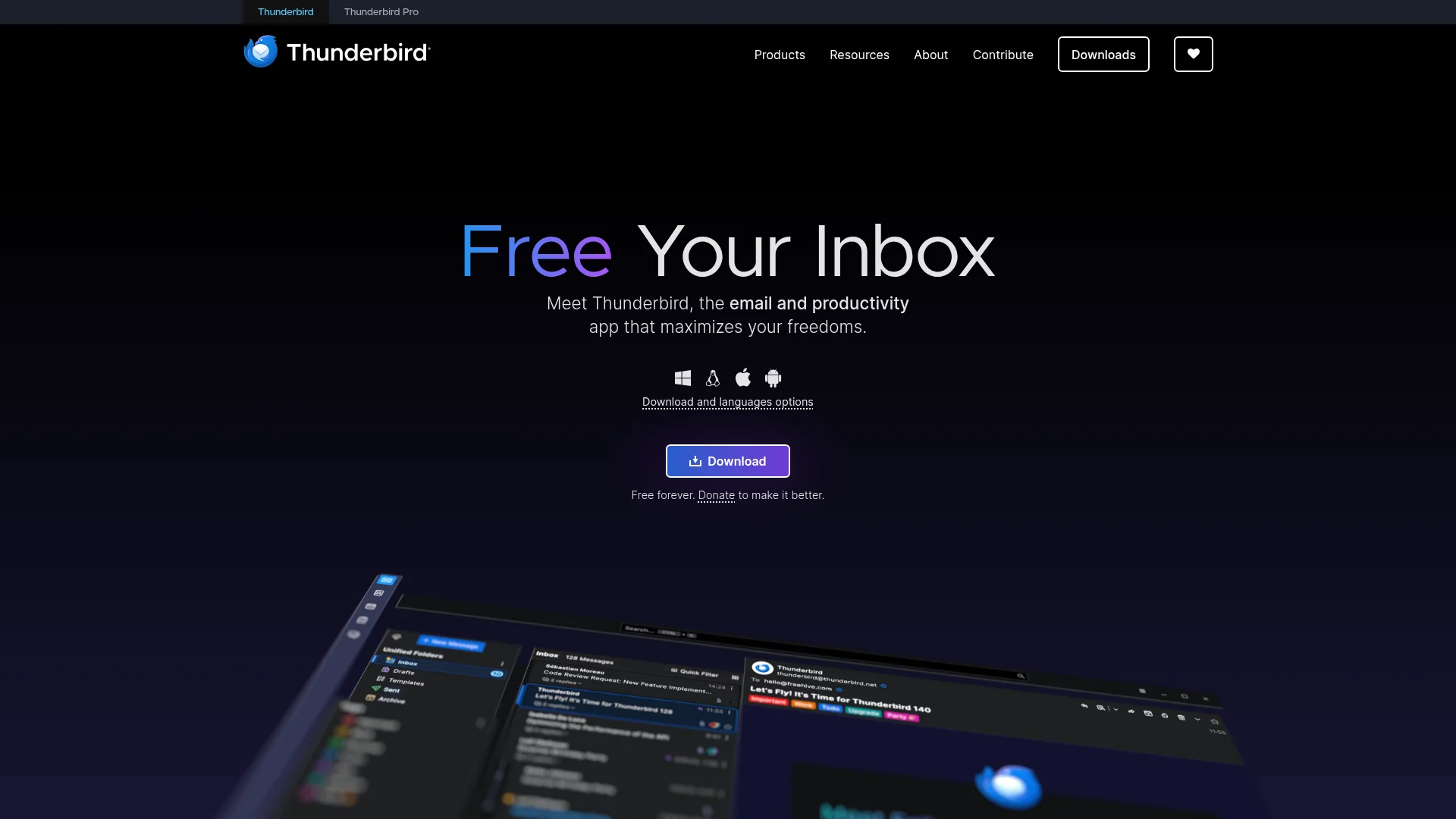
Thunderbird is a free, open-source email, calendar, and contacts app for Windows, Linux, and macOS. It offers a unified inbox, powerful customization, and strong privacy protection without ads or data collection.
Introduction to Thunderbird and Its Key Benefits
Thunderbird is a comprehensive email and productivity application designed to simplify digital communication. It consolidates messages, calendars, and contacts into one fast, efficient interface, reducing the need to switch between browser tabs. Users can manage multiple accounts separately or through a unified inbox, with flexible filtering and organization options.
As an open-source tool from the Mozilla family, Thunderbird prioritizes user privacy and security. It does not collect personal data, sell ads, or use private conversations for AI training. The app is funded entirely by donations, ensuring its development remains user-focused and transparent.
Getting Started with Thunderbird: A Quick Setup Guide
To begin using Thunderbird, download the appropriate version for your operating system from the official website. The installation process is straightforward, with versions available for Windows, macOS, and Linux. After installation, you can add your email accounts through the intuitive setup wizard.
Thunderbird automatically configures most popular email services, though manual settings can be adjusted if needed. Once accounts are added, you can immediately start organizing messages, setting up calendars, and customizing the interface to match your workflow preferences.
Top Features and Highlights of Thunderbird Email Client
- Unified Inbox: View messages from all accounts in one organized interface.
- Advanced Tagging System: Categorize and quickly locate important emails.
- Cross-Platform Compatibility: Works seamlessly on Windows, macOS, and Linux.
- Privacy Protection: No data collection, ad sales, or AI training with your emails.
- Extensive Customization: Modify appearance and functionality with themes and add-ons.
Who Benefits Most from Using Thunderbird Email Client
Professionals managing multiple email accounts for work and personal use benefit from Thunderbird. Privacy-conscious users seeking alternatives to commercial email services find it valuable. Developers and technical users appreciate its open-source nature.
Organizations needing a free, reliable email client for their teams can use Thunderbird effectively. Individuals who want to customize their email experience extensively will enjoy its flexibility. Users transitioning from other email clients seeking more control find Thunderbird empowering.
Thunderbird Help and Support Resources for Users
Thunderbird offers comprehensive support through detailed documentation and community forums. Users can find configuration guides, troubleshooting tips, and feature explanations in the help section. The active community provides additional assistance and shares customization ideas.
For enterprise users, specialized documentation addresses deployment and management in organizational environments. Regular updates ensure compatibility with evolving email standards and security requirements.
Reviews0
Would you recommend Thunderbird? Leave a comment
No reviews yet. Be the first to share your experience!
Alternatives
The best modern alternatives to Thunderbird
ChatGPT
5.0
Last update: 2 days ago
ChatGPT is an advanced AI chatbot developed by OpenAI that provides intelligent conversational assistance, content generation, and research support through natural language processing.
View ChatGPTTags:OpenAIFreeChat
View ChatGPTClaude
5.0
Claude is an AI assistant by Anthropic for content creation, code generation, data analysis, and team collaboration. Available with free and paid plans across web, mobile, and desktop platforms.
ClaudeAnthropicFree
View Claude
Figma Slides
5.0
Figma Slides is the first presentation tool built specifically for designers and their teams, combining collaborative features with design precision for creating presentations with interactive prototypes and real-time editing.
FigmaBrowser-BasedFree
View Figma Slides
Medium
5.0
Medium is a popular online publishing platform where writers, journalists, and thought leaders share stories, ideas, and insights. It combines a clean reading experience with tools for creators to publish content and build audiences.
Web AppFreeFor Creators
View Medium
Suno
5.0
Suno is an AI-powered music creation platform that transforms text prompts into complete songs with vocals and instrumentation. It offers a free tier with daily credits and paid plans for commercial use, advanced editing, and stem extraction.
FreeFreemiumFor Creators
View Suno
New Tools Releases
Recently added tools
Apache Subversion
5.0
Apache Subversion (SVN) is a robust, open-source, centralized version control system designed for managing code and project data. It offers reliability, simplicity, and scalability, making it suitable for individual developers and large enterprise operations. Subversion excels at tracking changes, facilitating collaboration, and ensuring data integrity. Its widespread adoption in both open-source
Open SourceGPLFor Developers
View Apache Subversion
Spamgourmet
5.0
Spamgourmet provides free, auto-creating email addresses that forward messages to your primary inbox and then expire, acting as a powerful spam blocker. It's ideal for anyone who wants to protect their main email from spam when signing up for new services or giving out contact information. The tool requires no installation and is designed for minimal user intervention after initial setup, making i
FreeWeb AppPrivacy-Focused
View Spamgourmet
Crew
5.0
Crew is a high-yield checking account that actively manages your finances through automated 'pockets,' paycheck splitting, and bill management. It offers a subscription-free approach to personal finance, empowering users with control and clarity over their money, alongside features like parental controls and competitive APY on deposits. Banking services are provided by Bangor Savings Bank, Member
Trial AvailableSubscription-BasedMobile App
View Crew
Ludwig
5.0
Ludwig is an open-source declarative deep learning framework that simplifies building, fine-tuning, and deploying ML models using a YAML file. It supports various data modalities and scales seamlessly from a laptop to distributed clusters, offering the flexibility of PyTorch with the ease of AutoML.
Open SourceFor DevelopersAutomation
View Ludwig
Reeder
5.0
Reeder is a modern news reader that unifies RSS feeds, videos, podcasts, and social media into a single timeline. It features seamless cross-device syncing via iCloud, powerful custom filters, and a simple way to save links. Reeder prioritizes a clean interface and user privacy, making it an efficient tool for content consumption.
Desktop AppMobile AppmacOS
View Reeder
SurveyJS
5.0
SurveyJS is a powerful JavaScript library that enables developers to build custom survey and form management systems directly within their applications. It offers unparalleled flexibility through JSON-based configuration, ensuring users retain full ownership of their data and can handle an unlimited number of responses. The latest version, v3.0, introduces significant enhancements like a shared st
Open SourceFor Developers
View SurveyJS
Small Basic
5.0
Small Basic is a free, beginner-friendly programming language developed by Microsoft, designed to make coding accessible and fun for learners of all ages. It simplifies complex programming concepts with an easy-to-understand syntax and a built-in Integrated Development Environment (IDE) that includes helpful features like syntax highlighting and debugging tools. This educational tool empowers user
Open SourceFor StudentsFor Teachers
View Small Basic
Scenari Dokiel
5.0
Scenari Dokiel is a high-performance distributed ledger technology utilizing a hybrid consensus mechanism for rapid transactions. Ideal for DeFi, supply chain management, and gaming, its scalable and secure architecture empowers developers to build next-generation decentralized applications with confidence and efficiency.
AutomationWeb3Open Source
View Scenari Dokiel