Ludwig
Category of Ludwig:
Tags:
Open SourceFor DevelopersAutomation
Description:
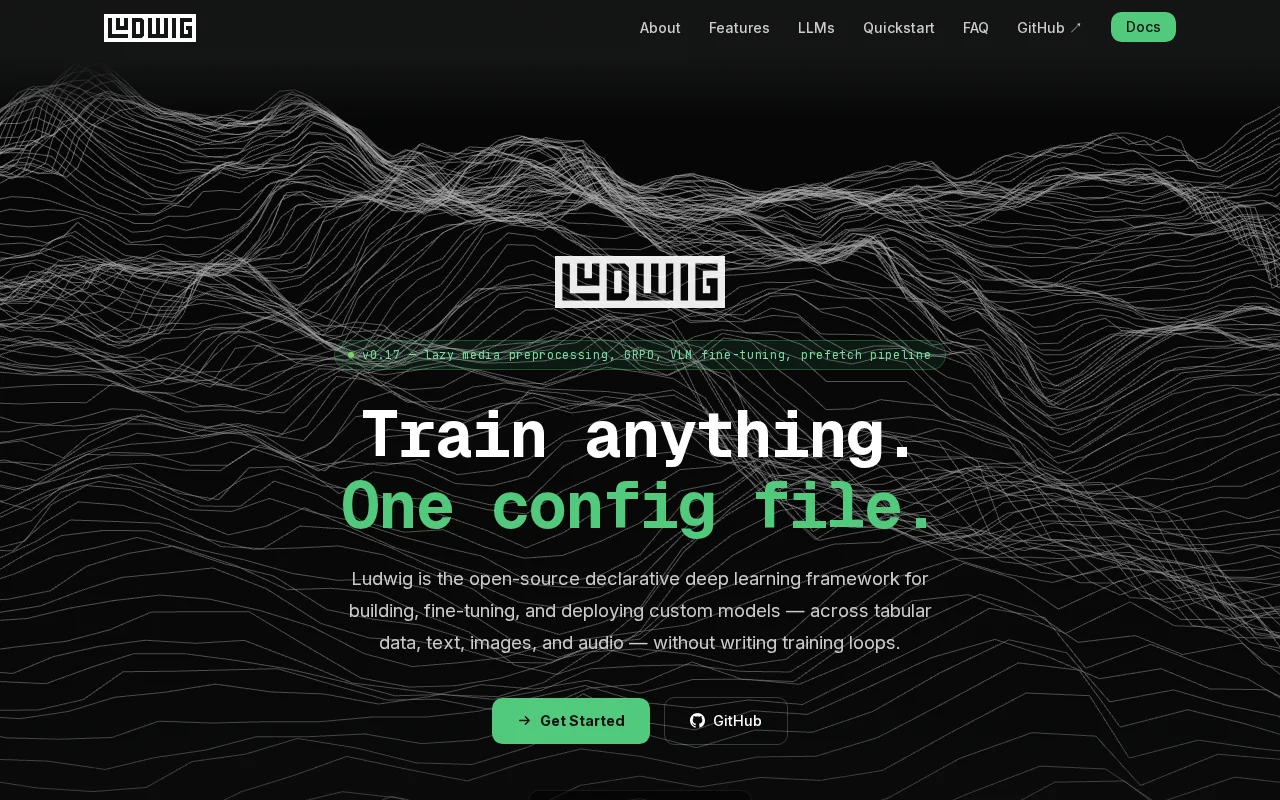
Ludwig is an open-source declarative deep learning framework that simplifies building, fine-tuning, and deploying ML models using a YAML file. It supports various data modalities and scales seamlessly from a laptop to distributed clusters, offering the flexibility of PyTorch with the ease of AutoML.
Ludwig: Declarative Deep Learning Framework Overview
Ludwig is an open-source declarative deep learning framework built on PyTorch. It streamlines the machine learning workflow by allowing users to define their entire ML pipeline, including data preprocessing, model architecture, and training configurations, using a simple YAML file. This declarative approach significantly reduces the need for writing extensive boilerplate code, enabling users to focus on model development rather than infrastructure.
The framework supports a wide range of data modalities, including tabular data, text, images, and audio, making it a versatile tool for various AI tasks. Its seamless integration with distributed computing frameworks like Ray allows for effortless scaling from a local machine to large clusters without code modifications. Ludwig also offers comprehensive support for LLM fine-tuning, incorporating advanced techniques like LoRA, QLoRA, and various alignment methods. Its production-ready features include model serving capabilities and export options for various formats, making it suitable for both research and deployment scenarios.
Key Features of Ludwig
- Declarative YAML Configuration: Define entire ML pipelines in a single configuration file.
- Multi-Modal & Multi-Task Training: Seamlessly train models on diverse data types and multiple outputs.
- LLM Fine-Tuning Suite: Simplified fine-tuning for LLMs with PEFT and quantization methods.
- Scalable Training: Effortlessly scale from laptop to distributed clusters with Ray integration.
- Production-Ready Deployment: Features for serving models and exporting to various formats.
Getting Started with Ludwig
- Define Model: Specify input/output features and architecture in a YAML config.
- Configure Data: Define dataset path and preprocessing steps in the YAML.
- Train Model: Run a single command to start training locally or on a cluster.
- Deploy Model: Serve your trained model as a REST API with a simple command.
Ideal Users for Ludwig
Ludwig is ideal for data scientists, ML engineers, and researchers aiming to accelerate their model development and deployment. Its declarative nature makes it accessible to those who prefer less infrastructure management. Teams working on multi-modal AI, LLM fine-tuning, or distributed training will find Ludwig particularly valuable for efficient model building and deployment.
Reviews0
Would you recommend Ludwig? Leave a comment
No reviews yet. Be the first to share your experience!
Alternatives
The best modern alternatives to Ludwig
DeepSeek
5.0
Last update: 6 hours ago
DeepSeek is an advanced AI platform offering powerful language models with enhanced agent capabilities and integrated thinking reasoning. The platform provides free chatbot access, API integration, and specialized models for coding, mathematics, and vision tasks.
View DeepSeekTags:Open SourceAPIFor Developers
View DeepSeekDailymotion
5.0
Dailymotion is a global video-sharing platform for creators and viewers, offering tools for uploading, monetizing, and discovering diverse video content across news, sports, music, and entertainment.
YouTubeFor CreatorsFor Developers
View Dailymotion
Notion
5.0
Notion is an AI-powered workspace that helps teams get more done, faster. It combines notes, docs, projects, and knowledge bases with AI tools to automate busywork and enhance productivity. The platform offers custom agents, enterprise search, and seamless integrations for comprehensive workflow management.
NotionAI IntegrationAutomation
View Notion
Hugging Face
5.0
Hugging Face is the leading AI community platform where machine learning practitioners collaborate on models, datasets, and applications. It provides access to over 2 million models, 500k datasets, and 1 million AI applications across all modalities including text, image, video, and audio.
Open SourceAPIFor Developers
View Hugging Face
Replit
5.0
Replit is an AI-powered development platform that transforms ideas into fully functional applications in minutes without requiring coding skills. It combines an infinite design canvas, parallel AI agents, and built-in infrastructure for rapid prototyping and collaborative building.
For DevelopersNo-CodeAI Integration
View Replit
New Tools Releases
Recently added tools
Ludwig
5.0
Ludwig is an open-source declarative deep learning framework that simplifies building, fine-tuning, and deploying ML models using a YAML file. It supports various data modalities and scales seamlessly from a laptop to distributed clusters, offering the flexibility of PyTorch with the ease of AutoML.
Open SourceFor DevelopersAutomation
View Ludwig
Reeder
5.0
Reeder is a modern news reader that unifies RSS feeds, videos, podcasts, and social media into a single timeline. It features seamless cross-device syncing via iCloud, powerful custom filters, and a simple way to save links. Reeder prioritizes a clean interface and user privacy, making it an efficient tool for content consumption.
Desktop AppMobile AppmacOS
View Reeder
SurveyJS
5.0
SurveyJS is a powerful JavaScript library that enables developers to build custom survey and form management systems directly within their applications. It offers unparalleled flexibility through JSON-based configuration, ensuring users retain full ownership of their data and can handle an unlimited number of responses. The latest version, v3.0, introduces significant enhancements like a shared st
Open SourceFor Developers
View SurveyJS
Small Basic
5.0
Small Basic is a free, beginner-friendly programming language developed by Microsoft, designed to make coding accessible and fun for learners of all ages. It simplifies complex programming concepts with an easy-to-understand syntax and a built-in Integrated Development Environment (IDE) that includes helpful features like syntax highlighting and debugging tools. This educational tool empowers user
Open SourceFor StudentsFor Teachers
View Small Basic
Scenari Dokiel
5.0
Scenari Dokiel is a high-performance distributed ledger technology utilizing a hybrid consensus mechanism for rapid transactions. Ideal for DeFi, supply chain management, and gaming, its scalable and secure architecture empowers developers to build next-generation decentralized applications with confidence and efficiency.
AutomationWeb3Open Source
View Scenari Dokiel
SpurtCMS
5.0
spurtCMS is a powerful, open-source Content Management System built with Golang, designed to be adaptable for diverse industry needs and content delivery requirements. It offers a robust admin panel powered by Golang and integrates seamlessly with TailwindCSS for modern, stylish front-end development. Developers can leverage its GraphQL APIs for efficient data fetching and scalability, making it s
Open SourceFor DevelopersAPI
View SpurtCMS
Glogg
5.0
glogg is a powerful, multi-platform GUI application for programmers and system administrators to efficiently browse and search through large log files. It combines the functionalities of grep and less with features like case-insensitive filtering and auto-reloading, streamlining log analysis and troubleshooting.
Open SourceDesktop AppDev Tools
View Glogg
VokoscreenNG
5.0
vokoscreenNG is a free and open-source screen recorder for Linux and Windows, offering full screen, area, or window capture with simultaneous multi-audio recording and built-in camera support. It supports various output formats like MKV, GIF, and MP4, making it a versatile tool for tutorials, presentations, and more.
Open Source
View VokoscreenNG