
JUnit
Category of JUnit:
Tags:
Open SourceFor DevelopersDev Tools
Description:
JUnit is the leading testing framework for Java and JVM developers, providing a modern foundation for writing robust unit tests. It supports various testing styles and requires Java 17 or higher, along with Kotlin 2.1+. JUnit empowers developers to build reliable software by enabling comprehensive testing strategies. Its extensive documentation and active community make it an indispensable tool fo
What Is JUnit?
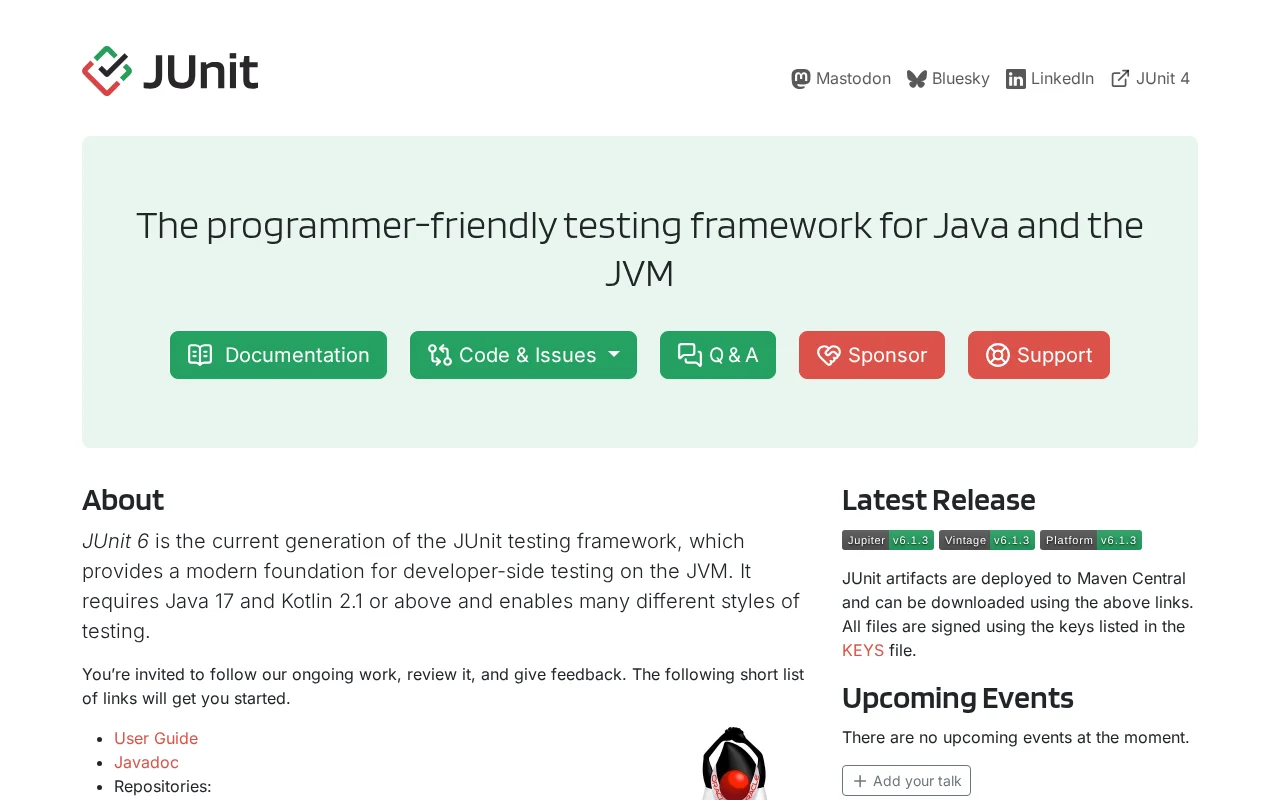
JUnit is a programmer-friendly testing framework designed for Java and the JVM. It provides a robust foundation for developer-side testing, enabling the creation of reliable and maintainable code. With its latest iteration, JUnit 6, the framework requires Java 17 and Kotlin 2.1 or above, offering modern features and supporting diverse testing methodologies. It is an essential tool for developers aiming to ensure the quality and stability of their applications.
The framework's primary goal is to facilitate comprehensive unit testing, allowing developers to isolate, test, and verify individual components of their software. This practice is crucial for identifying and resolving bugs early in the development lifecycle, leading to more stable and performant applications. JUnit's design emphasizes ease of use and integration into existing development workflows, making it a popular choice for projects of all sizes.
Key Features and Capabilities of JUnit
- Modern JVM Testing: Leverages Java 17 and Kotlin 2.1+ for advanced features.
- Multiple Testing Styles: Supports various approaches to suit different testing needs.
- Extensive Documentation: Comprehensive user guides and Javadoc for easy reference.
- Active Community Support: Discussions and Q&A forums for help and feedback.
- Open Source Development: Available on GitHub and Codeberg for transparency and collaboration.
Who JUnit Is Built For
- Java Developers
- JVM Developers
- Software Engineers
- Testers and QA Professionals
- Open Source Contributors
Getting Started with JUnit
To begin using JUnit, ensure you have Java 17 or a later version installed, along with Kotlin 2.1 or higher. Integrate JUnit into your project's build system (e.g., Maven or Gradle) by adding the necessary dependencies. Refer to the official User Guide and Javadoc for detailed instructions on writing and running your first tests. The project's GitHub repository also offers valuable insights and community discussions.
Limitations to Consider for JUnit
- Requires modern Java and Kotlin versions.
- Primarily focused on JVM-based languages.
- Community support relies on forums and GitHub discussions.
Support and Contact for JUnit
For questions and discussions, please visit the JUnit Discussions forum on GitHub. You can find the source code and report issues on GitHub or Codeberg. For commercial support and to help sustain development, consider sponsoring the project or exploring support options through OpenElements.
Reviews0
Would you recommend JUnit? Leave a comment
No reviews yet. Be the first to share your experience!
Alternatives
The best modern alternatives to JUnit
Cloudinary
5.0
Last update: 4 days ago
Cloudinary is a cloud-based media management platform for developers, streamlining image and video workflows from upload to delivery. It offers on-the-fly transformations, global CDN, and analytics to optimize media assets and enhance user experience.
View CloudinaryTags:For DevelopersVideoImages
View CloudinaryMetasploit
5.0
The Metasploit Framework is a leading open-source platform for developing, testing, and executing exploits. It is widely used by security professionals for penetration testing, vulnerability assessment, and security research. Metasploit offers a robust environment for discovering and leveraging software weaknesses, helping organizations understand and improve their security posture. Key benefits i
Open SourceFor DevelopersSecurity
View Metasploit
GTK
5.0
GTK is a free and open-source cross-platform widget toolkit for creating sophisticated graphical user interfaces. It offers a comprehensive suite of UI elements, making it ideal for a wide range of projects, from simple utilities to complex application suites. Developers can leverage GTK with their preferred programming languages through various bindings, including C, Python, JavaScript, and Rust,
Open SourceDesktop AppAPI
View GTK
X64dbg
5.0
x64dbg is a powerful open-source debugger for Windows, offering robust debugging capabilities for both 64-bit and 32-bit applications. Its intuitive interface, combined with advanced features like a C-like expression parser, memory map, and dynamic stack view, makes it an indispensable tool for reverse engineers, security researchers, and developers. The debugger supports extensive customization t
WindowsOpen SourceFor Developers
View X64dbg
Mockoon
5.0
Mockoon is the leading open-source tool for rapidly creating and running mock REST API servers. Designed for ease of use and speed, it requires no complex setup, remote deployment, or account creation, making it ideal for developers seeking a quick and efficient way to simulate APIs. Mockoon integrates seamlessly with existing workflows, supporting the OpenAPI specification and offering advanced f
Open SourceCLI ToolAPI
View Mockoon
New Tools Releases
Recently added tools
Crew
5.0
Crew is a high-yield checking account that actively manages your finances through automated 'pockets,' paycheck splitting, and bill management. It offers a subscription-free approach to personal finance, empowering users with control and clarity over their money, alongside features like parental controls and competitive APY on deposits. Banking services are provided by Bangor Savings Bank, Member
Trial AvailableSubscription-BasedMobile App
View Crew
Ludwig
5.0
Ludwig is an open-source declarative deep learning framework that simplifies building, fine-tuning, and deploying ML models using a YAML file. It supports various data modalities and scales seamlessly from a laptop to distributed clusters, offering the flexibility of PyTorch with the ease of AutoML.
Open SourceFor DevelopersAutomation
View Ludwig
Reeder
5.0
Reeder is a modern news reader that unifies RSS feeds, videos, podcasts, and social media into a single timeline. It features seamless cross-device syncing via iCloud, powerful custom filters, and a simple way to save links. Reeder prioritizes a clean interface and user privacy, making it an efficient tool for content consumption.
Desktop AppMobile AppmacOS
View Reeder
SurveyJS
5.0
SurveyJS is a powerful JavaScript library that enables developers to build custom survey and form management systems directly within their applications. It offers unparalleled flexibility through JSON-based configuration, ensuring users retain full ownership of their data and can handle an unlimited number of responses. The latest version, v3.0, introduces significant enhancements like a shared st
Open SourceFor Developers
View SurveyJS
Small Basic
5.0
Small Basic is a free, beginner-friendly programming language developed by Microsoft, designed to make coding accessible and fun for learners of all ages. It simplifies complex programming concepts with an easy-to-understand syntax and a built-in Integrated Development Environment (IDE) that includes helpful features like syntax highlighting and debugging tools. This educational tool empowers user
Open SourceFor StudentsFor Teachers
View Small Basic
Scenari Dokiel
5.0
Scenari Dokiel is a high-performance distributed ledger technology utilizing a hybrid consensus mechanism for rapid transactions. Ideal for DeFi, supply chain management, and gaming, its scalable and secure architecture empowers developers to build next-generation decentralized applications with confidence and efficiency.
AutomationWeb3Open Source
View Scenari Dokiel
SpurtCMS
5.0
spurtCMS is a powerful, open-source Content Management System built with Golang, designed to be adaptable for diverse industry needs and content delivery requirements. It offers a robust admin panel powered by Golang and integrates seamlessly with TailwindCSS for modern, stylish front-end development. Developers can leverage its GraphQL APIs for efficient data fetching and scalability, making it s
Open SourceFor DevelopersAPI
View SpurtCMS
Glogg
5.0
glogg is a powerful, multi-platform GUI application for programmers and system administrators to efficiently browse and search through large log files. It combines the functionalities of grep and less with features like case-insensitive filtering and auto-reloading, streamlining log analysis and troubleshooting.
Open SourceDesktop AppDev Tools
View Glogg