Flutter
Category of Flutter:
Tags:
Open SourceFor DevelopersFor Startups
Description:
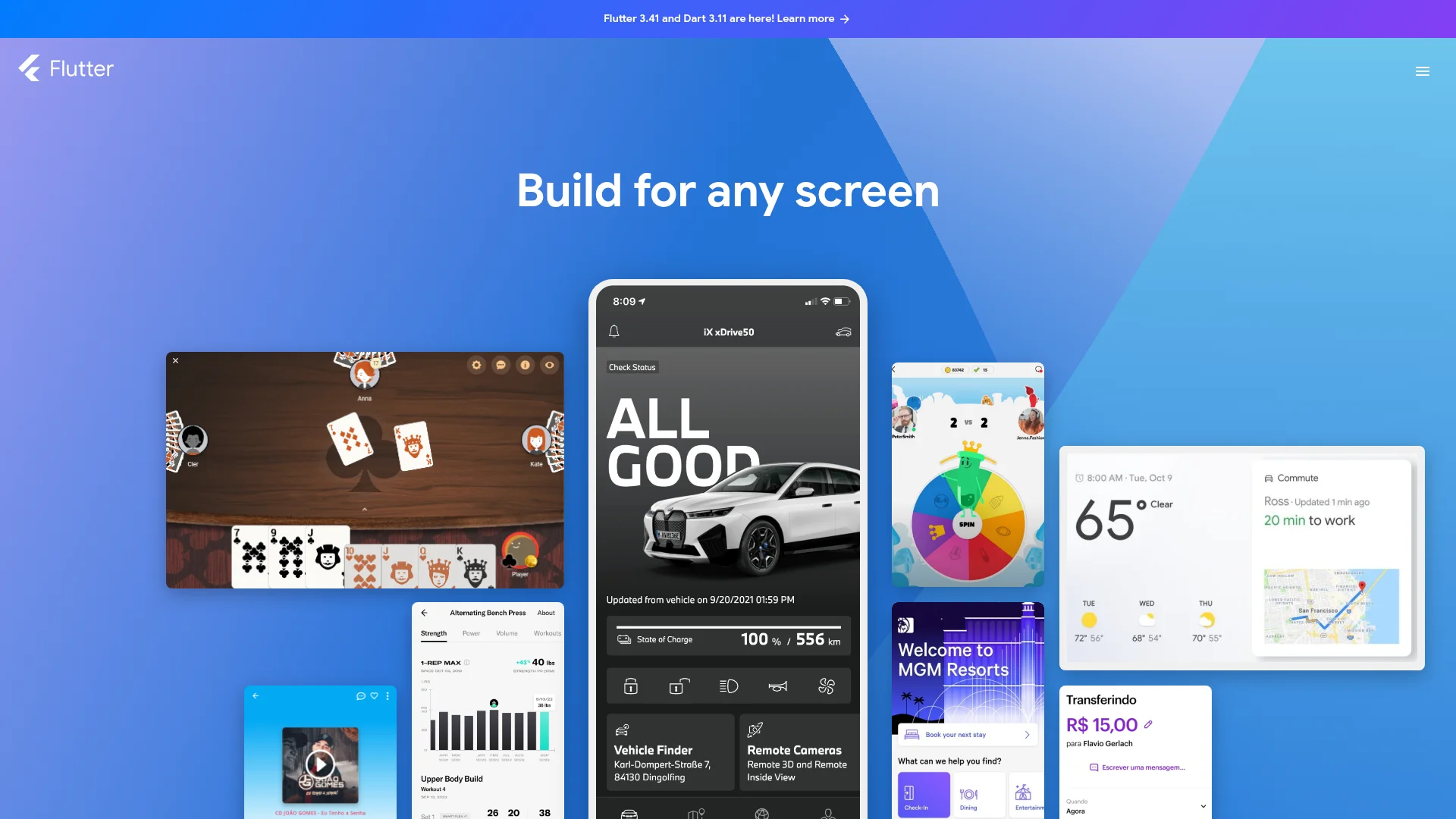
Flutter is an open-source UI software development kit created by Google for building natively compiled applications for mobile, web, desktop, and embedded devices from a single codebase.
Introduction to Flutter and Its Benefits
Flutter revolutionizes application development by providing a unified framework for creating cross-platform experiences. Developers can write code once and deploy it across iOS, Android, web, desktop, and embedded devices, significantly reducing development time and maintenance overhead.
The framework's widget-based architecture allows for complete control over every pixel, enabling highly customized and adaptive user interfaces. Built on the Dart programming language, Flutter compiles to native ARM or Intel machine code as well as JavaScript, delivering exceptional performance across all target platforms.
This approach eliminates the performance bottlenecks often associated with traditional cross-platform solutions, resulting in smooth animations and responsive applications that feel truly native on each device. The framework's extensive ecosystem includes thousands of packages available through pub.dev, covering everything from state management to integration with popular services.
This rich collection of resources accelerates development and ensures developers have access to the tools they need for building production-ready applications.
Getting Started with Flutter: Quick Setup Guide
Beginning with Flutter is straightforward, with comprehensive documentation and installation guides available for all major operating systems. Developers can download the Flutter SDK and set up their preferred development environment, whether using Android Studio, Visual Studio Code, or other supported editors.
The setup process includes configuring platform-specific dependencies for the target devices. Once installed, developers can create their first project using the Flutter CLI and immediately begin building with the framework's extensive widget library.
The included sample applications and codelabs provide practical examples for learning core concepts, while the active community offers support through forums, GitHub discussions, and regular events.
Top Features and Highlights of Flutter
- Hot Reload: Instantly view code changes without restarting the application.
- Custom Widgets: Build beautiful UIs with extensive widget library.
- Native Performance: Compiles to native code for optimal speed.
- Single Codebase: Develop once, deploy to multiple platforms.
- Rich Ecosystem: Access thousands of packages and tools.
Who Benefits Most from Flutter
Mobile app developers seeking cross-platform solutions benefit greatly from Flutter. Startups needing rapid MVP development and deployment find it particularly valuable. Enterprise teams maintaining consistent brand experiences across platforms also leverage Flutter effectively.
Web developers expanding to mobile applications appreciate the unified approach. Design-focused teams requiring pixel-perfect interfaces find Flutter's widget system ideal. Educational institutions teaching modern development use Flutter for its comprehensive documentation and community support.
Flutter Help and Support Resources
Flutter offers extensive documentation, community forums, and official support channels for developers. The framework's active GitHub repository provides issue tracking and contribution opportunities, while regular blog updates keep users informed about new features and best practices.
For support, contact the community through official channels.
Reviews0
Would you recommend Flutter? Leave a comment
No reviews yet. Be the first to share your experience!
Alternatives
The best modern alternatives to Flutter
DeepSeek
5.0
Last update: 9 hours ago
DeepSeek is an advanced AI platform offering powerful language models with enhanced agent capabilities and integrated thinking reasoning. The platform provides free chatbot access, API integration, and specialized models for coding, mathematics, and vision tasks.
View DeepSeekTags:Open SourceAPIFor Developers
View DeepSeekDailymotion
5.0
Dailymotion is a global video-sharing platform for creators and viewers, offering tools for uploading, monetizing, and discovering diverse video content across news, sports, music, and entertainment.
YouTubeFor CreatorsFor Developers
View Dailymotion
Hugging Face
5.0
Hugging Face is the leading AI community platform where machine learning practitioners collaborate on models, datasets, and applications. It provides access to over 2 million models, 500k datasets, and 1 million AI applications across all modalities including text, image, video, and audio.
Open SourceAPIFor Developers
View Hugging Face
MongoDB
5.0
MongoDB is a leading modern data platform designed to accelerate the delivery of ideas to market. Its flexible, AI-ready database simplifies data management for developers, enabling faster innovation and application development. MongoDB's powerful features and robust infrastructure make it an ideal choice for businesses looking to handle complex data challenges with ease and efficiency. Whether yo
For DevelopersDatabase SupportRealtime Updates
View MongoDB
Qt Framework
5.0
Qt Framework is a comprehensive cross-platform software development framework for building applications that run seamlessly across desktop, mobile, and embedded systems with minimal code changes.
Open SourceDesktop AppMobile App
View Qt Framework
New Tools Releases
Recently added tools
Automad
5.0
Automad is a fast, lightweight, and flexible flat-file content management system and template engine designed for creatives. It offers an intuitive dashboard with a block editor and in-page editing capabilities, eliminating the need for a database by storing all content in human-readable text files. This approach simplifies version control and makes managing your website straightforward. Despite i
Open SourceFor Creators
View Automad
Boost.ai
5.0
Boost.ai is a leading conversational AI platform trusted by regulated industries for its robust security, privacy, and auditability features. The platform empowers enterprises to deliver exceptional customer experiences through advanced agentic AI capabilities, enabling seamless self-service across chat and voice channels. It offers a hybrid AI approach, integrating generative AI for hyper-persona
For EnterprisesAutomation
View Boost.ai
Newshosting
5.0
Newshosting offers a comprehensive solution for Usenet access and online privacy, bundling a high-speed Usenet service with a robust VPN. It provides unlimited VPN access, secure SSL encryption, advanced threat protection, and ad blocking for a safe and private online experience. With extensive article retention and a vast server network, Newshosting ensures unparalleled access to Usenet content,
Subscription-BasedProprietaryWeb App
View Newshosting
Paperwork
5.0
Paperwork is an intuitive personal document management solution designed to streamline the organization and retrieval of your important files. By transforming scanned documents into searchable digital assets, it eliminates the need for manual filing and tedious searching. Ideal for individuals and small businesses seeking an efficient way to manage their paperwork, Paperwork offers intelligent sor
Open SourceDesktop AppDocument Creation
View Paperwork
Glyphr Studio
5.0
Glyphr Studio is a free, open-source, browser-based font editor designed for hobbyists and beginners. It allows users to import various font formats, utilize familiar vector editing tools, combine glyphs, and export custom typefaces directly from their browser, offering an accessible entry into font design without the need for complex professional software.
Open SourceWeb AppBrowser-Based
View Glyphr Studio
OpenPay
5.0
OpenPay is an advanced AI-powered platform designed specifically for subscription businesses to optimize revenue and enhance customer retention. It tackles common pain points such as high transaction fees by offering intelligent routing, robust payment recovery mechanisms, and actionable AI-driven insights, all consolidated into a single, user-friendly interface. This comprehensive solution aims t
View OpenPay
Tide
5.0
Tide is a nature-themed wellness application designed to help users find calm and focus amidst a busy life. It offers natural soundscapes paired with dedicated 'Focus' and 'Sleep' modules. By immersing users in peaceful, quiet environments, Tide aims to reduce anxiety and stress, improve concentration, and promote better sleep. The app is recognized for its minimalist design and effective tools fo
Trial AvailableMobile AppHealth
View Tide
Hitabs
5.0
Hitabs is an innovative online tool designed to streamline how users save, organize, and share their digital resources. Whether you're collecting articles to read later, bookmarking valuable websites, or curating links for a project, Hitabs offers a centralized and intuitive platform. It caters to students, researchers, professionals, and anyone looking to manage their online information more effe
Browser-BasedWeb AppLightweight
View Hitabs